
Anal polyps
Anal polyps are small growths of the lining of the anal canal. They are mostly benign, but they can bleed, cause pressure or a mucous discharge – and only a histological examination, to which we send every removed polyp, can assess them with certainty. At Proctocare, polyps are diagnosed and removed on an outpatient basis by MUDr. Karim Masalkhi, a proctologist with more than 20 years of experience and over 2000 successfully operated patients.
- Polyp removal including histology; the exact price is confirmed by the doctor after the initial examination
- The procedure is led by MUDr. Karim Masalkhi, on an outpatient basis and with no hospital stay
- An appointment with no referral, acute cases within 24 hours, even on weekends
Bratislava – Bernolákova 9 (STEIN II) | Žilina – Alexandra Rudnaya 100
What anal polyps are
An anal polyp is a small growth of the lining of the anal canal or the transitional zone of the rectum. It often develops as a hypertrophied anal papilla – an enlarged natural fold of the lining – as a result of chronic irritation, inflammation, hemorrhoids or an anal fissure. A polyp can be stalked or flat, and sometimes it slides out of the anus during a bowel movement.
It is important to distinguish polyps of the anal canal from polyps of the colon and rectum. Bowel polyps sit deeper, can turn into a malignant tumor over time, and finding and removing them belongs in the hands of a gastroenterologist during a colonoscopy. If the examination raises a suspicion that the problems come from higher parts of the bowel, we will recommend a colonoscopy.
How anal polyps show themselves
Small polyps can be completely symptom-free for a long time
- rectal bleeding – traces of blood on the stool or on the toilet paper
- a feeling of pressure, a foreign body or incomplete emptying
- a mucous discharge from the anus
- discomfort or irritation during emptying
- a palpable growth, or one that slides out during a bowel movement
Never automatically put rectal bleeding down to hemorrhoids – read more about the possible causes on the page blood in stool.
Why anal polyps develop
The exact cause is usually a combination of several factors
Chronic irritation and inflammation
Long-term irritation of the lining of the anal canal – for example from diarrhea, constipation or inflammation – encourages the enlargement of the mucosal folds.
Hemorrhoids and an anal fissure
Polyps, especially hypertrophied anal papillae, often accompany long-standing hemorrhoidal disease or a chronic anal fissure.
Pressure during emptying
Repeated hard straining with hard stool mechanically stresses the lining and contributes to the growths protruding and enlarging.
Age and lifestyle
With age, a diet low in fiber and a sedentary routine, the risk of mucosal changes in the anal area increases.
Diagnosis of anal polyps
A polyp is reliably detected by a proctological examination complemented by an anoscopy or rectoscopy – a short examination with modern optics that directly visualizes the anal canal and rectum, allows the size and shape of the polyp to be assessed, and distinguishes it from hemorrhoids, warts or skin tags.
The definitive answer to what type of growth it is, however, comes only from a histological examination. That is why at Proctocare we follow the rule: every removed polyp goes to histology. You gain certainty, and the doctor gains a precise diagnosis on which any further care is based.
Treatment at our clinic – gentle outpatient removal
The procedure is done under local anesthesia, with no hospital stay; you go home shortly after the treatment
Precise diagnostics with optics
Before the procedure we visualize the polyp precisely with an anoscope or rectoscope and rule out other causes of the problems.
Outpatient removal
We remove the polyp gently under local anesthesia, with no general anesthesia and no hospital stay – usually within a few minutes.
Histology of every polyp
We send every removed polyp for histological examination, which determines its nature with certainty.
We remove an anal polyp including histological examination. You will find the complete price list on a separate page; the doctor confirms the exact price after the initial examination.
When to see a doctor
A growth in the anus deserves an examination, even if it does not hurt
- you repeatedly notice blood on the stool or on the toilet paper
- you have felt a growth, or something slides out of the anus during a bowel movement
- you have a feeling of pressure, a foreign body or incomplete emptying
- mucus comes from the anus or your underwear is soiled
- the problems last more than two weeks or are getting worse
Book an examination
You get an appointment quickly and with no referral; we examine acute cases within 24 hours, even on weekends. Call +421 948 687 667.
Frequently asked questions about anal polyps
Polyps of the anal canal are benign in most cases. Certainty, however, comes only from a histological examination, which is why we send every removed polyp to histology. The situation is different with colon polyps, which can turn malignant over time – those are dealt with by colonoscopy.
An anal polyp grows directly in the anal canal, and we remove it on an outpatient basis under local anesthesia. Polyps of the colon and rectum sit deeper and are found and removed during a colonoscopy. If the examination raises a suspicion that the problems have a bowel origin, we will recommend a colonoscopy.
We do the procedure on an outpatient basis under local anesthesia, so the removal itself does not hurt. It usually takes only a few minutes, and you go home shortly afterwards; no hospital stay or general anesthesia is needed.
The doctor confirms the exact price of removing an anal polyp including histological examination after the initial examination, according to the size and number of polyps.
Neither the naked eye nor optics can determine with one hundred percent certainty what type of tissue it is. A histological examination under the microscope definitively confirms the nature of the growth and rules out a more serious finding – it is a standard of safe medicine that we follow consistently.
A completely removed polyp rarely returns in the same place. However, if the cause of the irritation persists – for example untreated hemorrhoids, an anal fissure or chronic constipation – new growths can develop over time. That is why treating the cause is also part of the treatment.
Related topics
Blood in stool
All the things that can cause rectal bleeding and when to have it examined without delay.
Anal warts
Wart-like growths caused by the HPV virus that can resemble polyps.
Anal skin tags
Skin tags and skin folds – harmless growths that patients often mistake for polyps.
Who will take care of you

MUDr. Karim Masalkhi
Founder and head physician of the Proctocare clinic · surgeon – proctologist
A recognized specialist with more than 20 years of experience in minimally invasive proctology and laser surgery, with over 2000 successfully operated patients. He regularly attends training placements abroad focused on the most modern techniques of minimally invasive surgery, proctology and surgical oncology.
- Certified in the LHP® method – he was the first to bring laser surgery of hemorrhoids and anal fissures to Slovakia
- A specialist in correcting unsuccessful proctological surgeries of hemorrhoids and anal fissures
- He personally guarantees expertise, safety and a considerate approach to every patient
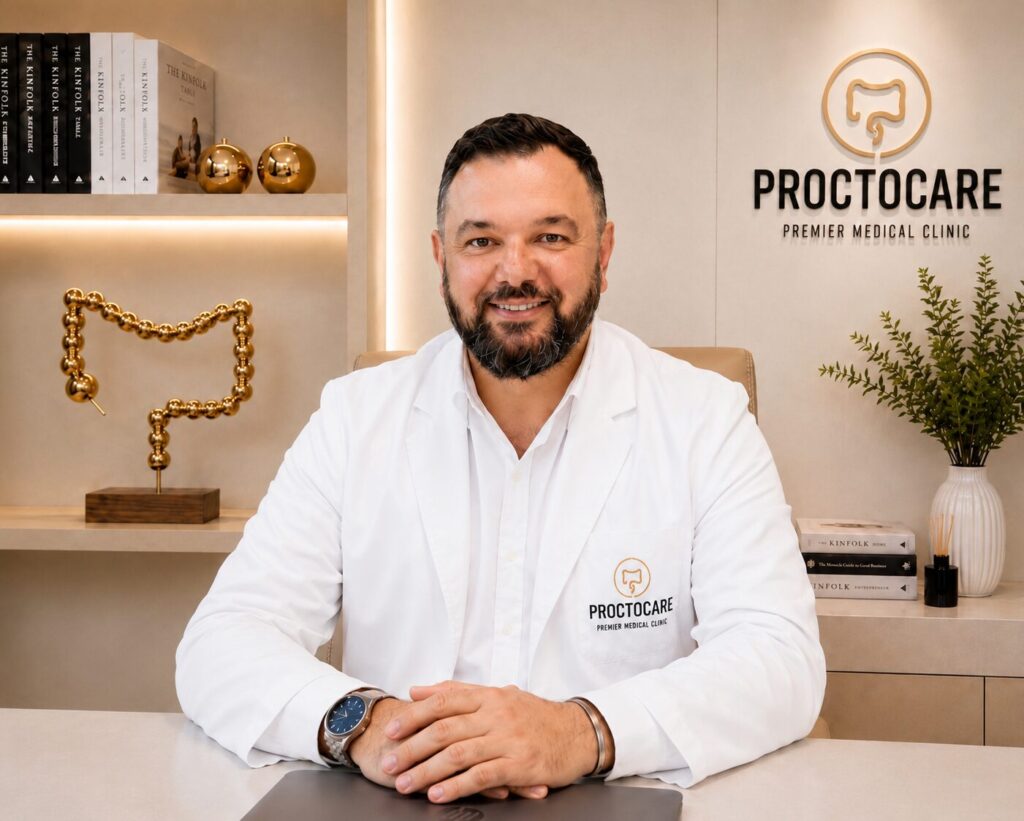
MUDr. Manuchekhr Burkhanov
Proctologist · office: Bratislava
He focuses on the diagnosis and outpatient treatment of proctological conditions – hemorrhoids, anal fissure and other disorders of the rectum – with a discreet and individual approach. He communicates with patients in Slovak, Russian and English.

MUDr. Matúš Kačeriak
Surgeon – proctologist · office: Žilina
At the Proctocare office in Žilina you will be cared for by MUDr. Matúš Kačeriak – a surgeon at the surgical department of the FNsP Žilina hospital. He focuses on proctological examinations, diagnosis of rectal disorders and minimally invasive proctological procedures with an emphasis on precise diagnosis and individual care.
Author and medical review: Your health is in the hands of MUDr. Karim Masalkhi – founder and head physician of the Proctocare clinic, a proctologist with more than 20 years of experience and over 2000 treated patients. · Last medical review: July 2026
Suspect an anal polyp? We examine it and remove it gently
An outpatient procedure by MUDr. Karim Masalkhi including histology, with no hospital stay – an appointment within 24 hours, even on weekends.
Bratislava: Bernolákova 9, 811 07 (STEIN II) · Mon–Fri 07:30–19:30, Sat 07:30–12:30
Žilina: Alexandra Rudnaya 100, 010 01 · by appointment
info@proctocare.sk
Anal polyps
Anal polyps are small growths of the lining of the anal canal. They are mostly benign, but they can bleed, cause pressure or a mucous discharge – and only a histological examination, to which we send every removed polyp, can assess them with certainty. At Proctocare, polyps are diagnosed and removed on an outpatient basis by MUDr. Karim Masalkhi, a proctologist with more than 20 years of experience and over 2000 successfully operated patients.
- Polyp removal including histology; the exact price is confirmed by the doctor after the initial examination
- The procedure is led by MUDr. Karim Masalkhi, on an outpatient basis and with no hospital stay
- An appointment with no referral, acute cases within 24 hours, even on weekends
Bratislava – Bernolákova 9 (STEIN II) | Žilina – Alexandra Rudnaya 100
What anal polyps are
An anal polyp is a small growth of the lining of the anal canal or the transitional zone of the rectum. It often develops as a hypertrophied anal papilla – an enlarged natural fold of the lining – as a result of chronic irritation, inflammation, hemorrhoids or an anal fissure. A polyp can be stalked or flat, and sometimes it slides out of the anus during a bowel movement.
It is important to distinguish polyps of the anal canal from polyps of the colon and rectum. Bowel polyps sit deeper, can turn into a malignant tumor over time, and finding and removing them belongs in the hands of a gastroenterologist during a colonoscopy. If the examination raises a suspicion that the problems come from higher parts of the bowel, we will recommend a colonoscopy.
How anal polyps show themselves
Small polyps can be completely symptom-free for a long time
- rectal bleeding – traces of blood on the stool or on the toilet paper
- a feeling of pressure, a foreign body or incomplete emptying
- a mucous discharge from the anus
- discomfort or irritation during emptying
- a palpable growth, or one that slides out during a bowel movement
Never automatically put rectal bleeding down to hemorrhoids – read more about the possible causes on the page blood in stool.
Why anal polyps develop
The exact cause is usually a combination of several factors
Chronic irritation and inflammation
Long-term irritation of the lining of the anal canal – for example from diarrhea, constipation or inflammation – encourages the enlargement of the mucosal folds.
Hemorrhoids and an anal fissure
Polyps, especially hypertrophied anal papillae, often accompany long-standing hemorrhoidal disease or a chronic anal fissure.
Pressure during emptying
Repeated hard straining with hard stool mechanically stresses the lining and contributes to the growths protruding and enlarging.
Age and lifestyle
With age, a diet low in fiber and a sedentary routine, the risk of mucosal changes in the anal area increases.
Diagnosis of anal polyps
A polyp is reliably detected by a proctological examination complemented by an anoscopy or rectoscopy – a short examination with modern optics that directly visualizes the anal canal and rectum, allows the size and shape of the polyp to be assessed, and distinguishes it from hemorrhoids, warts or skin tags.
The definitive answer to what type of growth it is, however, comes only from a histological examination. That is why at Proctocare we follow the rule: every removed polyp goes to histology. You gain certainty, and the doctor gains a precise diagnosis on which any further care is based.
Treatment at our clinic – gentle outpatient removal
The procedure is done under local anesthesia, with no hospital stay; you go home shortly after the treatment
Precise diagnostics with optics
Before the procedure we visualize the polyp precisely with an anoscope or rectoscope and rule out other causes of the problems.
Outpatient removal
We remove the polyp gently under local anesthesia, with no general anesthesia and no hospital stay – usually within a few minutes.
Histology of every polyp
We send every removed polyp for histological examination, which determines its nature with certainty.
We remove an anal polyp including histological examination. You will find the complete price list on a separate page; the doctor confirms the exact price after the initial examination.
When to see a doctor
A growth in the anus deserves an examination, even if it does not hurt
- you repeatedly notice blood on the stool or on the toilet paper
- you have felt a growth, or something slides out of the anus during a bowel movement
- you have a feeling of pressure, a foreign body or incomplete emptying
- mucus comes from the anus or your underwear is soiled
- the problems last more than two weeks or are getting worse
Book an examination
You get an appointment quickly and with no referral; we examine acute cases within 24 hours, even on weekends. Call +421 948 687 667.
Frequently asked questions about anal polyps
Polyps of the anal canal are benign in most cases. Certainty, however, comes only from a histological examination, which is why we send every removed polyp to histology. The situation is different with colon polyps, which can turn malignant over time – those are dealt with by colonoscopy.
An anal polyp grows directly in the anal canal, and we remove it on an outpatient basis under local anesthesia. Polyps of the colon and rectum sit deeper and are found and removed during a colonoscopy. If the examination raises a suspicion that the problems have a bowel origin, we will recommend a colonoscopy.
We do the procedure on an outpatient basis under local anesthesia, so the removal itself does not hurt. It usually takes only a few minutes, and you go home shortly afterwards; no hospital stay or general anesthesia is needed.
The doctor confirms the exact price of removing an anal polyp including histological examination after the initial examination, according to the size and number of polyps.
Neither the naked eye nor optics can determine with one hundred percent certainty what type of tissue it is. A histological examination under the microscope definitively confirms the nature of the growth and rules out a more serious finding – it is a standard of safe medicine that we follow consistently.
A completely removed polyp rarely returns in the same place. However, if the cause of the irritation persists – for example untreated hemorrhoids, an anal fissure or chronic constipation – new growths can develop over time. That is why treating the cause is also part of the treatment.
Related topics
Blood in stool
All the things that can cause rectal bleeding and when to have it examined without delay.
Anal warts
Wart-like growths caused by the HPV virus that can resemble polyps.
Anal skin tags
Skin tags and skin folds – harmless growths that patients often mistake for polyps.
Who will take care of you
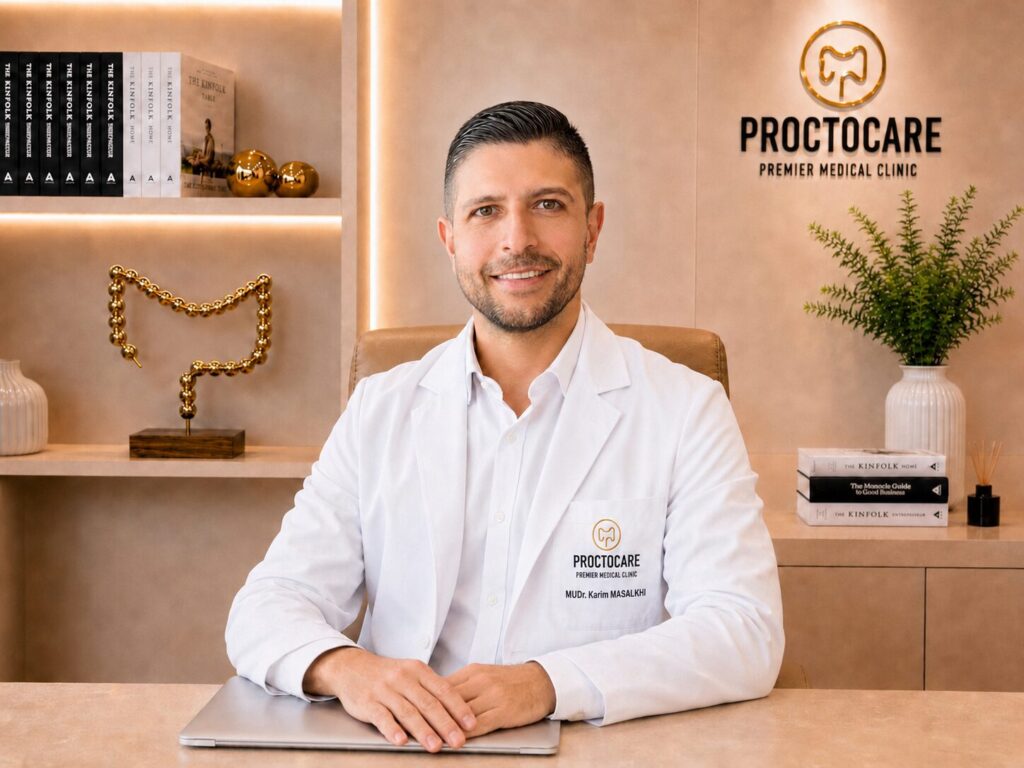
MUDr. Karim Masalkhi
Founder and head physician of the Proctocare clinic · surgeon – proctologist
A recognized specialist with more than 20 years of experience in minimally invasive proctology and laser surgery, with over 2000 successfully operated patients. He regularly attends training placements abroad focused on the most modern techniques of minimally invasive surgery, proctology and surgical oncology.
- Certified in the LHP® method – he was the first to bring laser surgery of hemorrhoids and anal fissures to Slovakia
- A specialist in correcting unsuccessful proctological surgeries of hemorrhoids and anal fissures
- He personally guarantees expertise, safety and a considerate approach to every patient
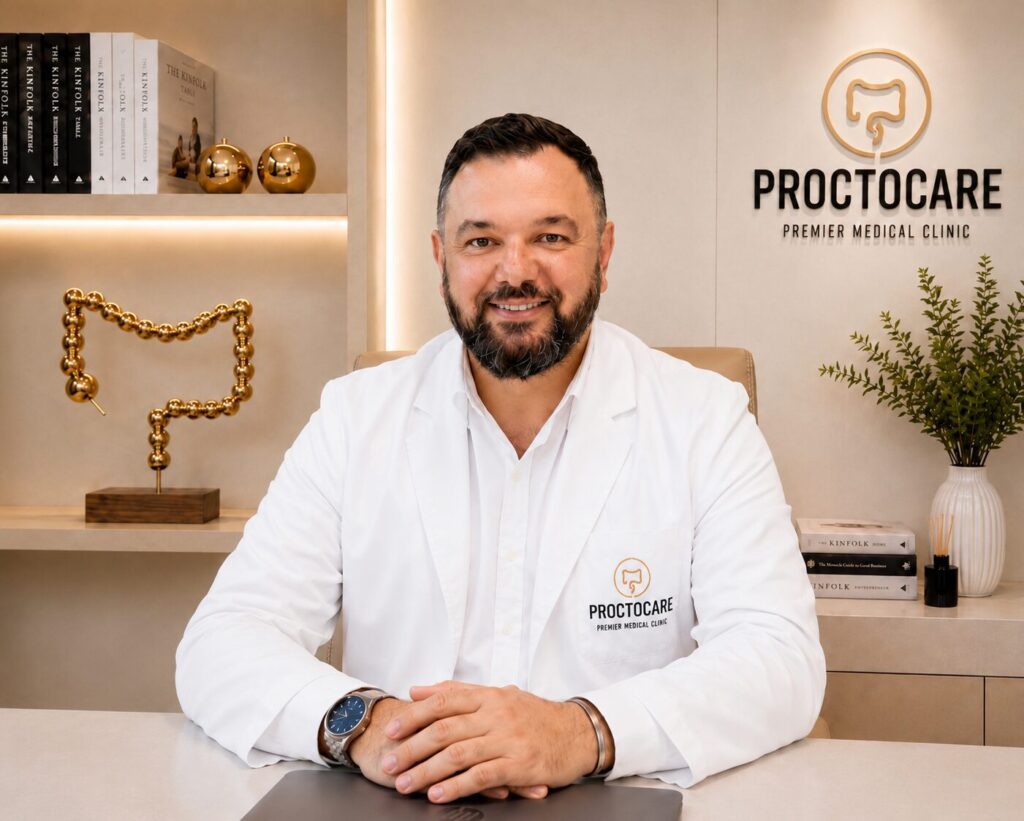
MUDr. Manuchekhr Burkhanov
Proctologist · office: Bratislava
He focuses on the diagnosis and outpatient treatment of proctological conditions – hemorrhoids, anal fissure and other disorders of the rectum – with a discreet and individual approach. He communicates with patients in Slovak, Russian and English.

MUDr. Matúš Kačeriak
Surgeon – proctologist · office: Žilina
At the Proctocare office in Žilina you will be cared for by MUDr. Matúš Kačeriak – a surgeon at the surgical department of the FNsP Žilina hospital. He focuses on proctological examinations, diagnosis of rectal disorders and minimally invasive proctological procedures with an emphasis on precise diagnosis and individual care.
Author and medical review: Your health is in the hands of MUDr. Karim Masalkhi – founder and head physician of the Proctocare clinic, a proctologist with more than 20 years of experience and over 2000 treated patients. · Last medical review: July 2026
Suspect an anal polyp? We examine it and remove it gently
An outpatient procedure by MUDr. Karim Masalkhi including histology, with no hospital stay – an appointment within 24 hours, even on weekends.
Bratislava: Bernolákova 9, 811 07 (STEIN II) · Mon–Fri 07:30–19:30, Sat 07:30–12:30
Žilina: Alexandra Rudnaya 100, 010 01 · by appointment
info@proctocare.sk
Anal polyps
Anal polyps are small growths of the lining of the anal canal. They are mostly benign, but they can bleed, cause pressure or a mucous discharge – and only a histological examination, to which we send every removed polyp, can assess them with certainty. At Proctocare, polyps are diagnosed and removed on an outpatient basis by MUDr. Karim Masalkhi, a proctologist with more than 20 years of experience and over 2000 successfully operated patients.
- Polyp removal including histology; the exact price is confirmed by the doctor after the initial examination
- The procedure is led by MUDr. Karim Masalkhi, on an outpatient basis and with no hospital stay
- An appointment with no referral, acute cases within 24 hours, even on weekends
Bratislava – Bernolákova 9 (STEIN II) | Žilina – Alexandra Rudnaya 100
What anal polyps are
An anal polyp is a small growth of the lining of the anal canal or the transitional zone of the rectum. It often develops as a hypertrophied anal papilla – an enlarged natural fold of the lining – as a result of chronic irritation, inflammation, hemorrhoids or an anal fissure. A polyp can be stalked or flat, and sometimes it slides out of the anus during a bowel movement.
It is important to distinguish polyps of the anal canal from polyps of the colon and rectum. Bowel polyps sit deeper, can turn into a malignant tumor over time, and finding and removing them belongs in the hands of a gastroenterologist during a colonoscopy. If the examination raises a suspicion that the problems come from higher parts of the bowel, we will recommend a colonoscopy.
How anal polyps show themselves
Small polyps can be completely symptom-free for a long time
- rectal bleeding – traces of blood on the stool or on the toilet paper
- a feeling of pressure, a foreign body or incomplete emptying
- a mucous discharge from the anus
- discomfort or irritation during emptying
- a palpable growth, or one that slides out during a bowel movement
Never automatically put rectal bleeding down to hemorrhoids – read more about the possible causes on the page blood in stool.
Why anal polyps develop
The exact cause is usually a combination of several factors
Chronic irritation and inflammation
Long-term irritation of the lining of the anal canal – for example from diarrhea, constipation or inflammation – encourages the enlargement of the mucosal folds.
Hemorrhoids and an anal fissure
Polyps, especially hypertrophied anal papillae, often accompany long-standing hemorrhoidal disease or a chronic anal fissure.
Pressure during emptying
Repeated hard straining with hard stool mechanically stresses the lining and contributes to the growths protruding and enlarging.
Age and lifestyle
With age, a diet low in fiber and a sedentary routine, the risk of mucosal changes in the anal area increases.
Diagnosis of anal polyps
A polyp is reliably detected by a proctological examination complemented by an anoscopy or rectoscopy – a short examination with modern optics that directly visualizes the anal canal and rectum, allows the size and shape of the polyp to be assessed, and distinguishes it from hemorrhoids, warts or skin tags.
The definitive answer to what type of growth it is, however, comes only from a histological examination. That is why at Proctocare we follow the rule: every removed polyp goes to histology. You gain certainty, and the doctor gains a precise diagnosis on which any further care is based.
Treatment at our clinic – gentle outpatient removal
The procedure is done under local anesthesia, with no hospital stay; you go home shortly after the treatment
Precise diagnostics with optics
Before the procedure we visualize the polyp precisely with an anoscope or rectoscope and rule out other causes of the problems.
Outpatient removal
We remove the polyp gently under local anesthesia, with no general anesthesia and no hospital stay – usually within a few minutes.
Histology of every polyp
We send every removed polyp for histological examination, which determines its nature with certainty.
We remove an anal polyp including histological examination. You will find the complete price list on a separate page; the doctor confirms the exact price after the initial examination.
When to see a doctor
A growth in the anus deserves an examination, even if it does not hurt
- you repeatedly notice blood on the stool or on the toilet paper
- you have felt a growth, or something slides out of the anus during a bowel movement
- you have a feeling of pressure, a foreign body or incomplete emptying
- mucus comes from the anus or your underwear is soiled
- the problems last more than two weeks or are getting worse
Book an examination
You get an appointment quickly and with no referral; we examine acute cases within 24 hours, even on weekends. Call +421 948 687 667.
Frequently asked questions about anal polyps
Polyps of the anal canal are benign in most cases. Certainty, however, comes only from a histological examination, which is why we send every removed polyp to histology. The situation is different with colon polyps, which can turn malignant over time – those are dealt with by colonoscopy.
An anal polyp grows directly in the anal canal, and we remove it on an outpatient basis under local anesthesia. Polyps of the colon and rectum sit deeper and are found and removed during a colonoscopy. If the examination raises a suspicion that the problems have a bowel origin, we will recommend a colonoscopy.
We do the procedure on an outpatient basis under local anesthesia, so the removal itself does not hurt. It usually takes only a few minutes, and you go home shortly afterwards; no hospital stay or general anesthesia is needed.
The doctor confirms the exact price of removing an anal polyp including histological examination after the initial examination, according to the size and number of polyps.
Neither the naked eye nor optics can determine with one hundred percent certainty what type of tissue it is. A histological examination under the microscope definitively confirms the nature of the growth and rules out a more serious finding – it is a standard of safe medicine that we follow consistently.
A completely removed polyp rarely returns in the same place. However, if the cause of the irritation persists – for example untreated hemorrhoids, an anal fissure or chronic constipation – new growths can develop over time. That is why treating the cause is also part of the treatment.
Related topics
Blood in stool
All the things that can cause rectal bleeding and when to have it examined without delay.
Anal warts
Wart-like growths caused by the HPV virus that can resemble polyps.
Anal skin tags
Skin tags and skin folds – harmless growths that patients often mistake for polyps.
Who will take care of you

MUDr. Karim Masalkhi
Founder and head physician of the Proctocare clinic · surgeon – proctologist
A recognized specialist with more than 20 years of experience in minimally invasive proctology and laser surgery, with over 2000 successfully operated patients. He regularly attends training placements abroad focused on the most modern techniques of minimally invasive surgery, proctology and surgical oncology.
- Certified in the LHP® method – he was the first to bring laser surgery of hemorrhoids and anal fissures to Slovakia
- A specialist in correcting unsuccessful proctological surgeries of hemorrhoids and anal fissures
- He personally guarantees expertise, safety and a considerate approach to every patient
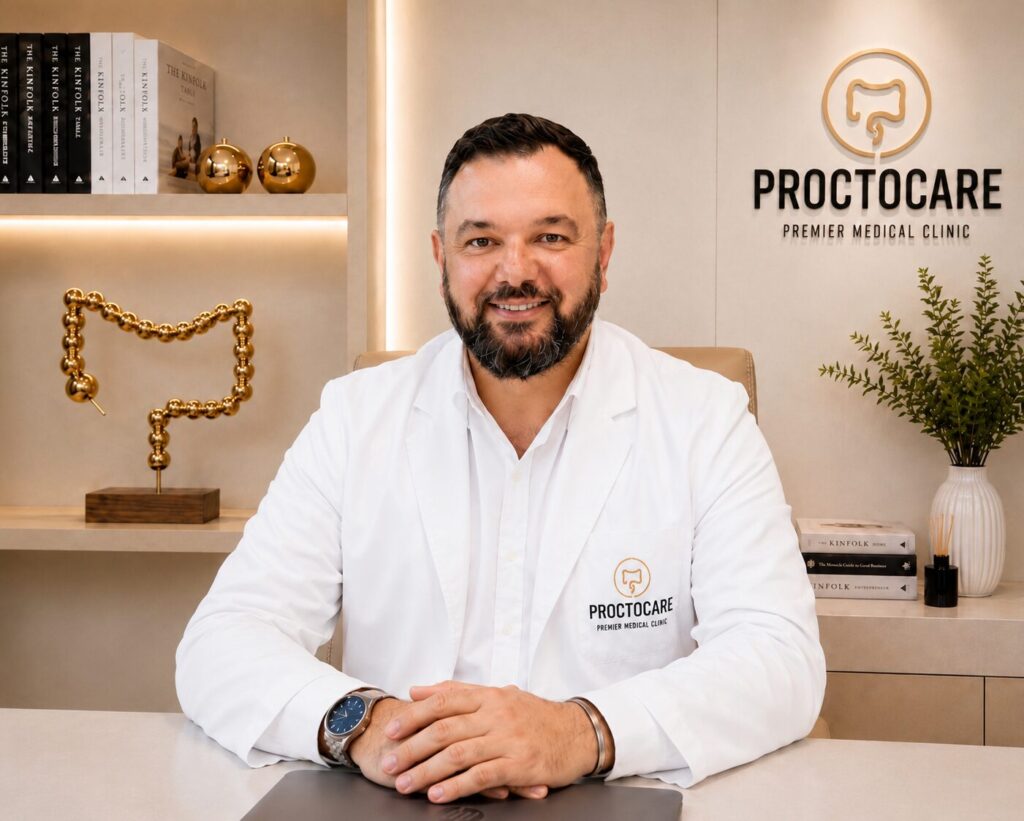
MUDr. Manuchekhr Burkhanov
Proctologist · office: Bratislava
He focuses on the diagnosis and outpatient treatment of proctological conditions – hemorrhoids, anal fissure and other disorders of the rectum – with a discreet and individual approach. He communicates with patients in Slovak, Russian and English.

MUDr. Matúš Kačeriak
Surgeon – proctologist · office: Žilina
At the Proctocare office in Žilina you will be cared for by MUDr. Matúš Kačeriak – a surgeon at the surgical department of the FNsP Žilina hospital. He focuses on proctological examinations, diagnosis of rectal disorders and minimally invasive proctological procedures with an emphasis on precise diagnosis and individual care.
Author and medical review: Your health is in the hands of MUDr. Karim Masalkhi – founder and head physician of the Proctocare clinic, a proctologist with more than 20 years of experience and over 2000 treated patients. · Last medical review: July 2026
Suspect an anal polyp? We examine it and remove it gently
An outpatient procedure by MUDr. Karim Masalkhi including histology, with no hospital stay – an appointment within 24 hours, even on weekends.
Bratislava: Bernolákova 9, 811 07 (STEIN II) · Mon–Fri 07:30–19:30, Sat 07:30–12:30
Žilina: Alexandra Rudnaya 100, 010 01 · by appointment
info@proctocare.sk